Explainer · token economics
What is token economics?
Definition
Token economics — tokenomics, in AI — treats the token as the unit of AI cost and of AI value: every token metered, attributed to the work it was spent on, and tied to an outcome, so you can say what a piece of work cost and whether it was worth it.
The token is the unit
Language models are priced per token: the text a model reads and the text it writes, with input, output and cached tokens at different rates, and different models at very different prices. That makes the token the natural unit of account for AI work, the way the compute hour is for cloud.
The FinOps Foundation puts it this way: Token economics is the unit-economic vocabulary of the AI era.
— J.R. Storment, FinOps Foundation.
Not the crypto kind
In crypto, tokenomics means the design of a token’s supply and incentives. In AI it means something else entirely: the cost and value of the tokens a model reads and writes. This page is about the second.
The questions it answers
A team that practises token economics can answer, for any piece of work:
- What did it cost? In tokens and in dollars, by model and by kind of token.
- Who and what was it for? The project, team or person, and the change it bought.
- Was it worth it? Did it ship — merged, reviewed, checks passed — or was it thrown away?
- Is it normal? How does it compare with similar work?
- Where does it stop? Which limit refuses the next run, and who can raise it?
The opposite: tokenmaxxing
Rewarding people for how many tokens they burn turns a cost into a score. That is tokenmaxxing, and it is what token economics replaces: the question changes from “what did we spend on AI this month?” to “what did this change cost, and was it worth it?”
Where Ticinuum fits
How Ticinuum fits: the piece of work is the unit of account.
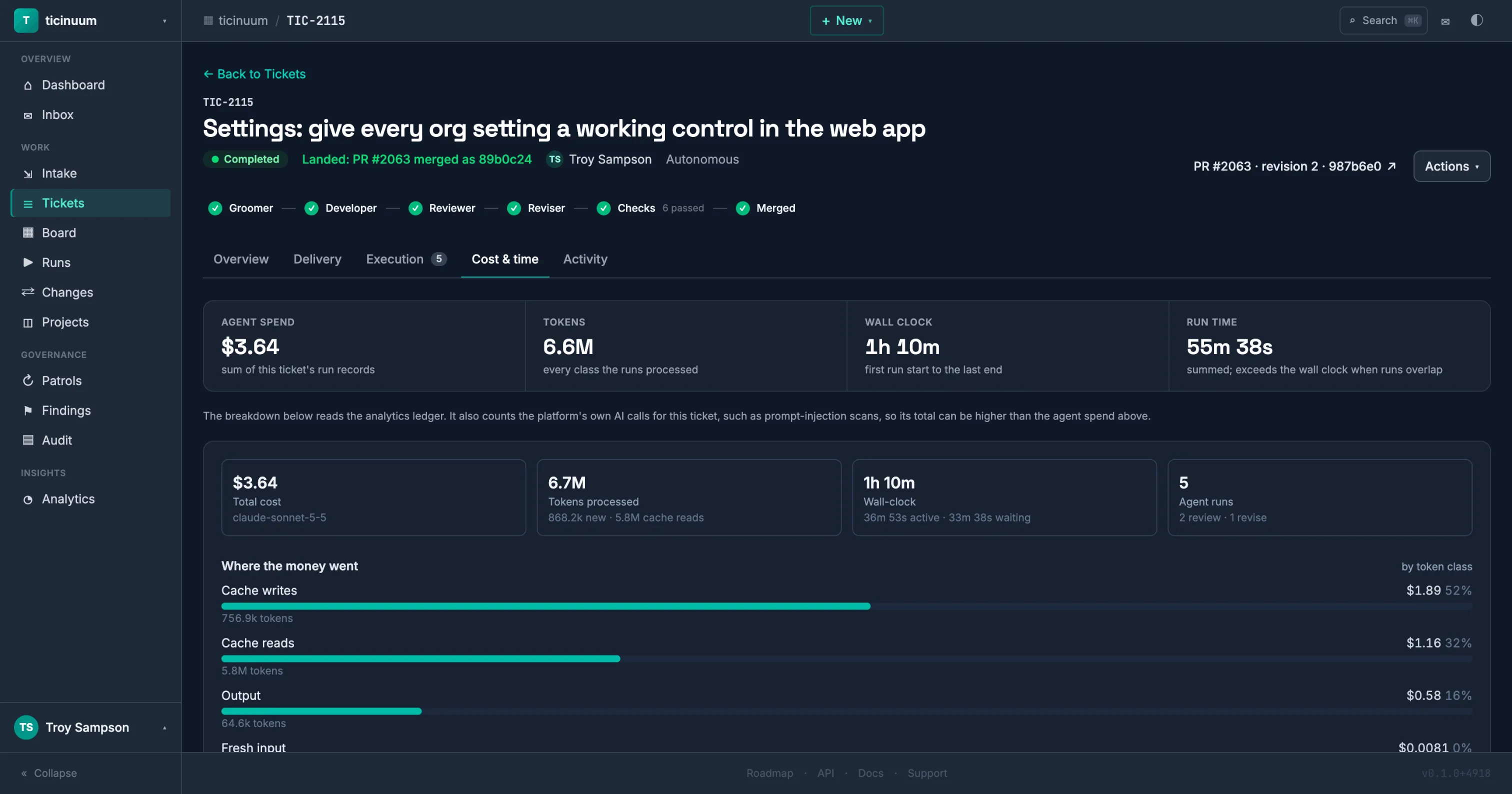
Every ticket in Ticinuum carries its own measured cost, from the runs that did the work, and that cost is tied to what the work delivered. Budgets sit where the money is, and they stop.
-
Metered from the run itself
Tokens come from the run’s real input and output counts and are stored, so the record survives later price changes. Dollars are those tokens at your provider’s published API rates; a run on a Claude subscription is recorded at $0 and shows its tokens.
Every token and dollar → -
Attributed to the ticket, rolled up to the feature
Each ticket shows where its money went, by model and token class, and rolls up into the feature it belongs to.
Cost controls → -
Compared with similar work
Once your organization has enough finished, priced work to compare against, a ticket shows how far it has drifted from what similar work usually costs and takes.
Ticket health → -
Engineers’ own sessions, counted too
With workstation metering on (it’s opt-in), a Claude Code session reports its tokens, model and latency, and Ticinuum attributes them to the ticket it was working on. Prompt content is never captured.
Claude Code & MCP → -
Budgets where the money is
A daily budget breaker per organization that fails closed, budgets per project, team or person by day, week or month, and per-run token, spend and time ceilings.
Budgets and ceilings → -
On your own model account
Agents run on your own model credential, so model spend lands on your provider account. Ticinuum adds no markup to it.
Your key, your quota →
- 1h 10m
- request to merged
- 5
- agent runs
- $3.64
- model usage at published API rates
- 2
- broken tests caught before merge
One real ticket from Ticinuum’s own backlog, TIC-2115 (October 18, 2026) — not an average. Its dollars are the runs’ tokens priced at Anthropic’s published API rates. The merge was the platform’s because Ticinuum’s own organization lets the agent merge; by default a person does.
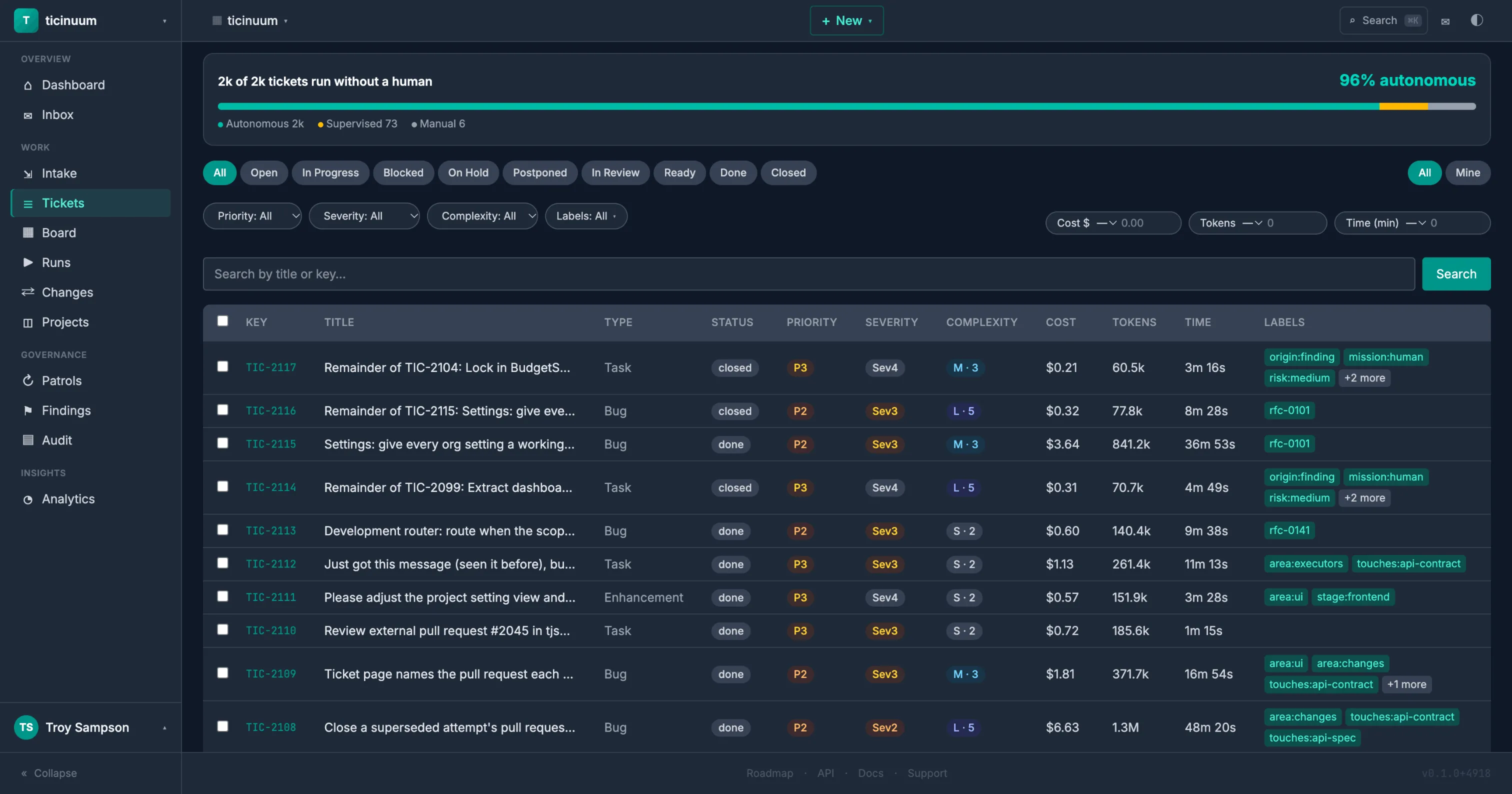
In the product
Captured from the product.
Real screens from Ticinuum’s own organization, taken in October 2026 — not mockups.
Said plainly
What Ticinuum doesn’t do here.
- Dollar figures are tokens priced at your provider’s published API rates — a measured cost, not your invoice.
- A run on a Claude subscription is recorded at $0 and shows its tokens only, so dollar limits don’t see it.
- Efficiency alerts and spend stewardship are built but not yet validated in use. Don’t rely on them yet.
- Ticinuum doesn’t quote a price before a run.
FAQ
Token economics: questions, answered plainly.
Is AI tokenomics related to crypto tokenomics?
Only by name. Crypto tokenomics is about a token’s supply and incentives; AI tokenomics is about the cost and value of the tokens a language model reads and writes. Ticinuum is about the second.
How is a run on a Claude subscription counted?
Its tokens are recorded in full, and its dollars at $0, because the subscription — not a per-token price — is what you pay. That means the daily breaker and the per-run dollar ceiling don’t see it; there the CLI’s own per-run budget and turn limits stand in.
How do you stop agents running away with my bill?
Independent layers. No build starts until someone asks for it. A global kill switch and a per-org daily budget breaker in real dollars — it auto-pauses the org on breach and fails closed — stop new work from starting, and budgets per project, team or person can refuse new runs at their own limits. Configurable per-run ceilings on tokens, dollars and time pause a single run before it balloons (a run on a Claude subscription is recorded at $0, so neither the breaker nor the dollar ceiling sees it — there the CLI’s own per-run budget and turn limits stand in), and the review loop stops the moment a round stops making progress. And an operator hard-stop cancels a run already in flight, cutting the model call within seconds.
Keep reading
The ideas behind Ticinuum.
Put your backlog on the continuum.
From intent to PR to review — one durable, auditable continuum of work. Join the early-access waitlist.