Human-in-the-loop approval for AI-written code.
Autonomy isn't all-or-nothing. Agents do the routine work on their own and ask for a person only where your policy says so — and by default, the final merge is still a person's click.
Early access ↓Governance & human-in-the-loop
Humans approve only where policy requires.
Autonomy isn't all-or-nothing. You set the policy; Ticinuum enforces it.
Agents request human approval only where policy requires it.
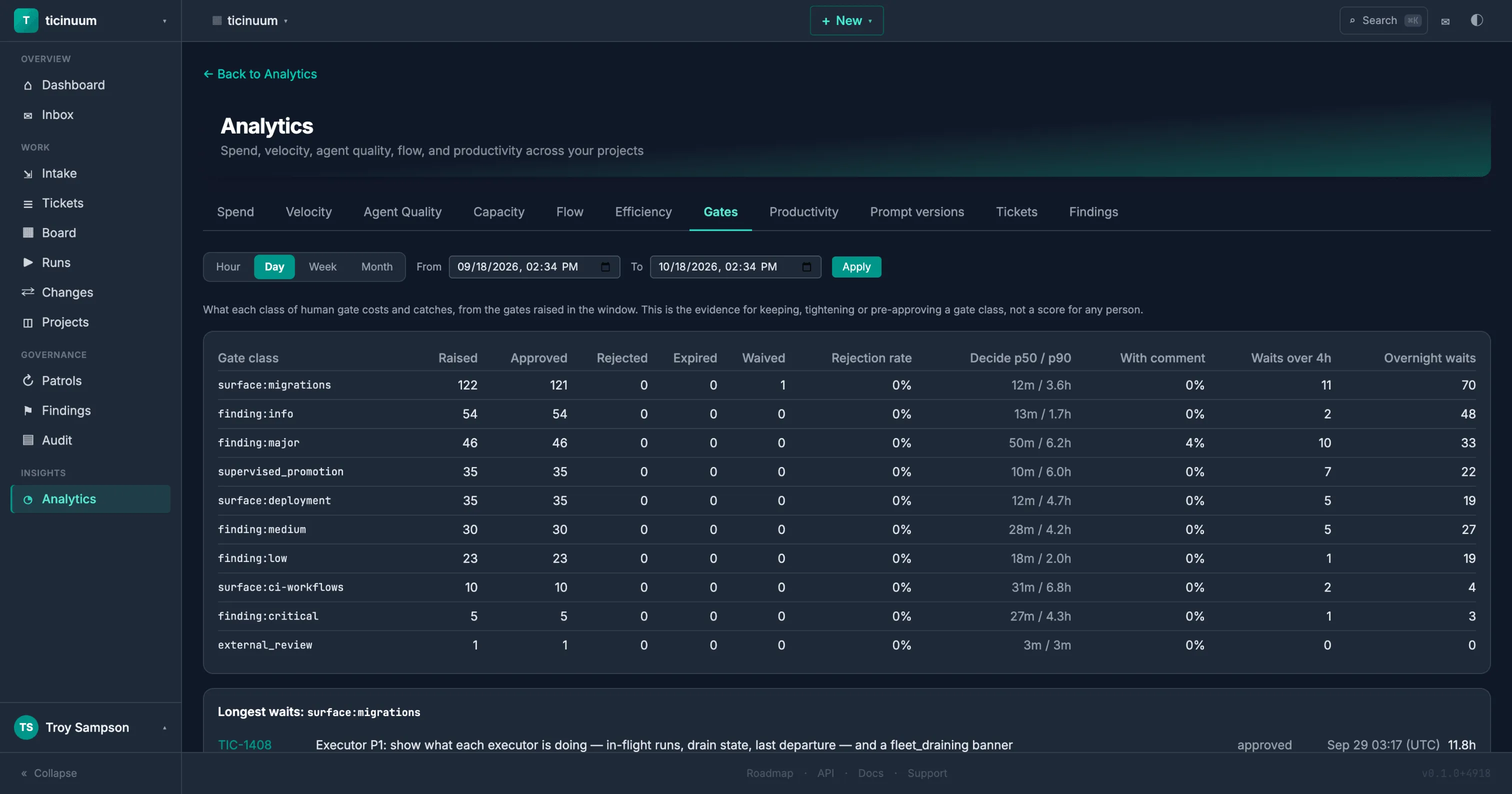
- Gates where they matter — a supervised ticket stops at a gate for a person to approve before it merges; when the automated loop escalates instead, the person who overrides it to merge cannot be the ticket's author or owner. A change that touches a surface your repo declares sensitive — migrations, an API or config contract, deployment — can require a human sign-off, a high-confidence critical or major finding raises a blocking gate, and an outside reviewer who requests changes on your git host holds the merge until they approve, the review is dismissed there, or a person overrides. Every gate says why it fired and where its rule lives.
- Merge on green, not on hope — the independent review gates every merge, autonomous included, and fails closed — it never passes a change it did not fully see, and a loop that stops making progress, or a review that failed, goes to a person with no merge. An approved PR then merges only once its CI checks pass — the checks your repository, git host or org requires, otherwise every check that reported; a repository with no CI waits for a person by default — and a merge conflict gets its own bounded, re-reviewed retry loop before a person is asked. Merges also wait, rather than escalate, while someone has frozen the base branch or its required checks are red, and are released one at a time, oldest approval first. A cancelled check never counts as a pass. Your git host still owns branch protection.
- “Done” means what was delivered — when the review finds a merged change covered only part of the ticket's goal, the ticket closes for what shipped and the rest is filed as its own remainder ticket — which starts nothing until someone runs it — instead of the whole thing being marked done.
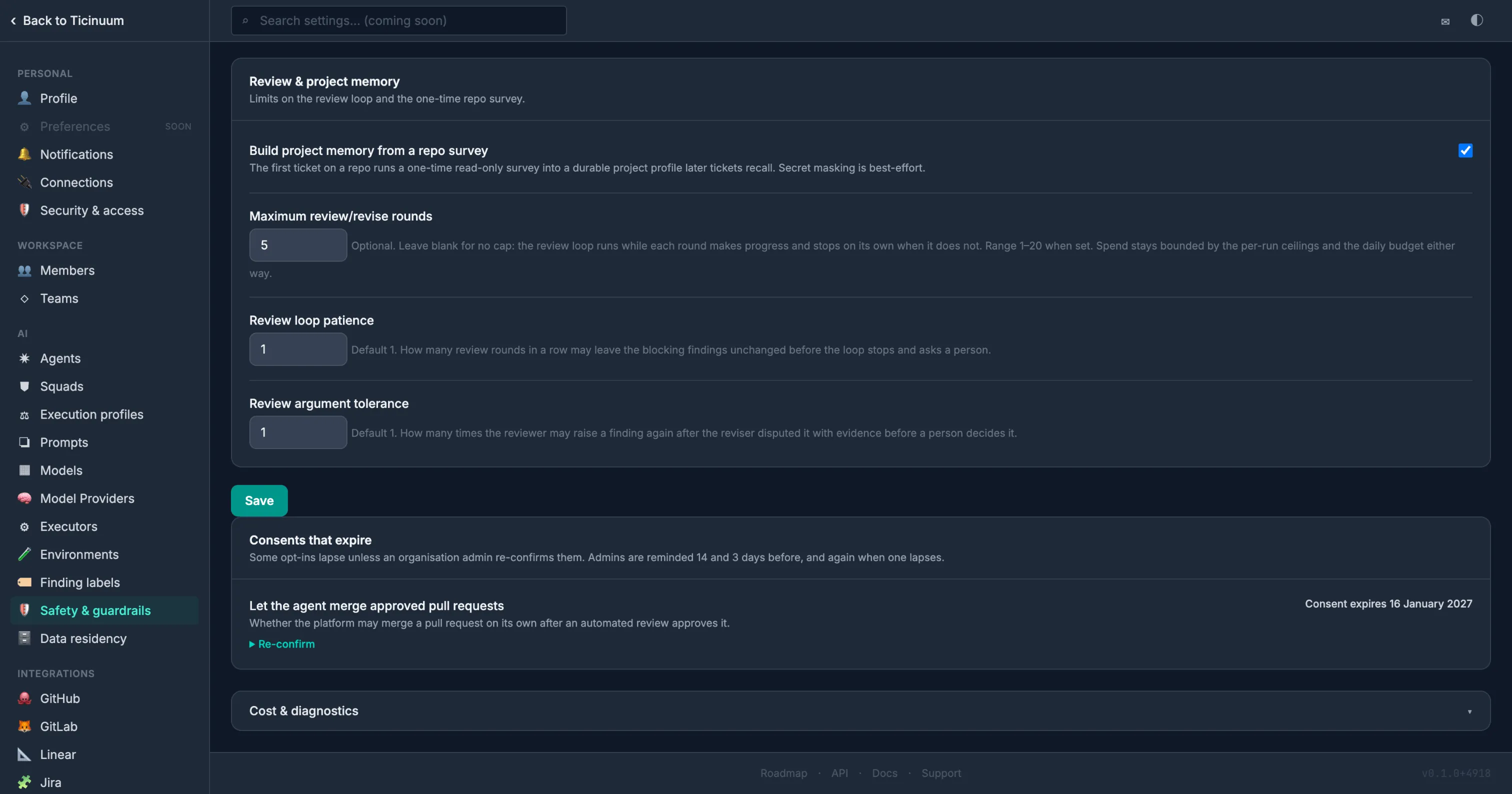
- The final merge is yours until you hand it over — by default an approved, green autonomous PR waits in review, and a “Merge needed” item asks its owner to merge it with one click. Letting the agent merge on its own is a separate setting your org admin elects against a recorded disclosure; the choice lapses after 90 days unless it is re-confirmed, and it is not yet available to orgs on GitLab. A revert is always merged by a person.
- Durable human-in-the-loop — when an agent needs a person it asks — the question arrives in the app, by email and by push, and waits in your Needs-You list — then pauses, snapshots its workspace and conversation, and resumes the exact conversation and workspace under the same run ID once someone answers, surviving crashes and restarts. An unanswered question holds the work instead of letting the agent guess, unless it named a harmless default up front.
- Take the wheel anytime — operators add steering notes the next agent run follows, put a ticket on hold so nothing acts on it, postpone it until a date or another ticket with a review date so it never quietly rots, fold a duplicate into the ticket that survives, and REVIVE or CANCEL it outright.
- Plans that avoid their own collisions — when a plan breaks work into tickets, the ones predicted to touch the same files are ordered one after another instead of racing — learned from your repository's own merge history (so it needs diffs kept), with no model call. A person can remove any ordering; the paths are a prediction, not a guarantee.
- A choice not in force is never silent — a consent that lapsed, a release that changed a default you relied on, a ceiling reached, a dependency stranded — each stays in front of an admin as a standing item until a person settles it. The platform never flips your choice back for you.
- Bounded delegation — a planning or investigating agent can hand a sub-task to a persona-pinned child — inside the ticket tree's size and depth caps, its budget, and a per-tree cost ceiling; never a free-running sub-agent. On a supervised ticket the child waits for a person to promote it.
- A role-scoped kill switch — a SystemAdmin stops new work for every org at once, or for an explicit set of them from a searchable picker; an OrgAdmin stops their own. Every halt and resume is authorized server-side and written to the audit trail with an actor and a reason.
- A SystemAdmin console — retune the operational tunables — the org daily budget, the dashboard estimate knobs, the feature toggles — at runtime, no redeploy, from one guarded console that also hosts the platform-wide controls.
- A lifecycle that is machine-governed, not draggable — every ticket is born backlog and must be groomed before it can reach open; from there it moves open → in_progress → in_review → ready → done through an enforced state machine. open means “groomed and cleared to start,” ready means “validated and ready to merge” — opposite ends of the run. It is not a board you drag cards across; it is a state machine the platform enforces.
Autonomy is a dial, and your organization holds it. By default a ticket a person files is autonomous, but filing it starts nothing: once groomed it waits for a person's Run, and from that one click it runs through implementation, review and revision — gated by the budget breaker, injection quarantine, progress-bounded loops, and kill switch, not by more clicks — and then a person merges the approved, green PR with one click. Letting the agent make that merge too, and a ranked pull that starts your backlog's top work under a work-in-progress limit, are each a separate opt-in your org admin elects against a recorded disclosure; the pull also needs a platform admin to expose it. Patrols your admin schedules and the next steps of a plan a person started run without another click. Prefer an earlier checkpoint? One per-org setting makes supervised your default, and any single ticket can be set supervised, so a person promotes it, starts it, and approves it before Ticinuum merges.
In the product
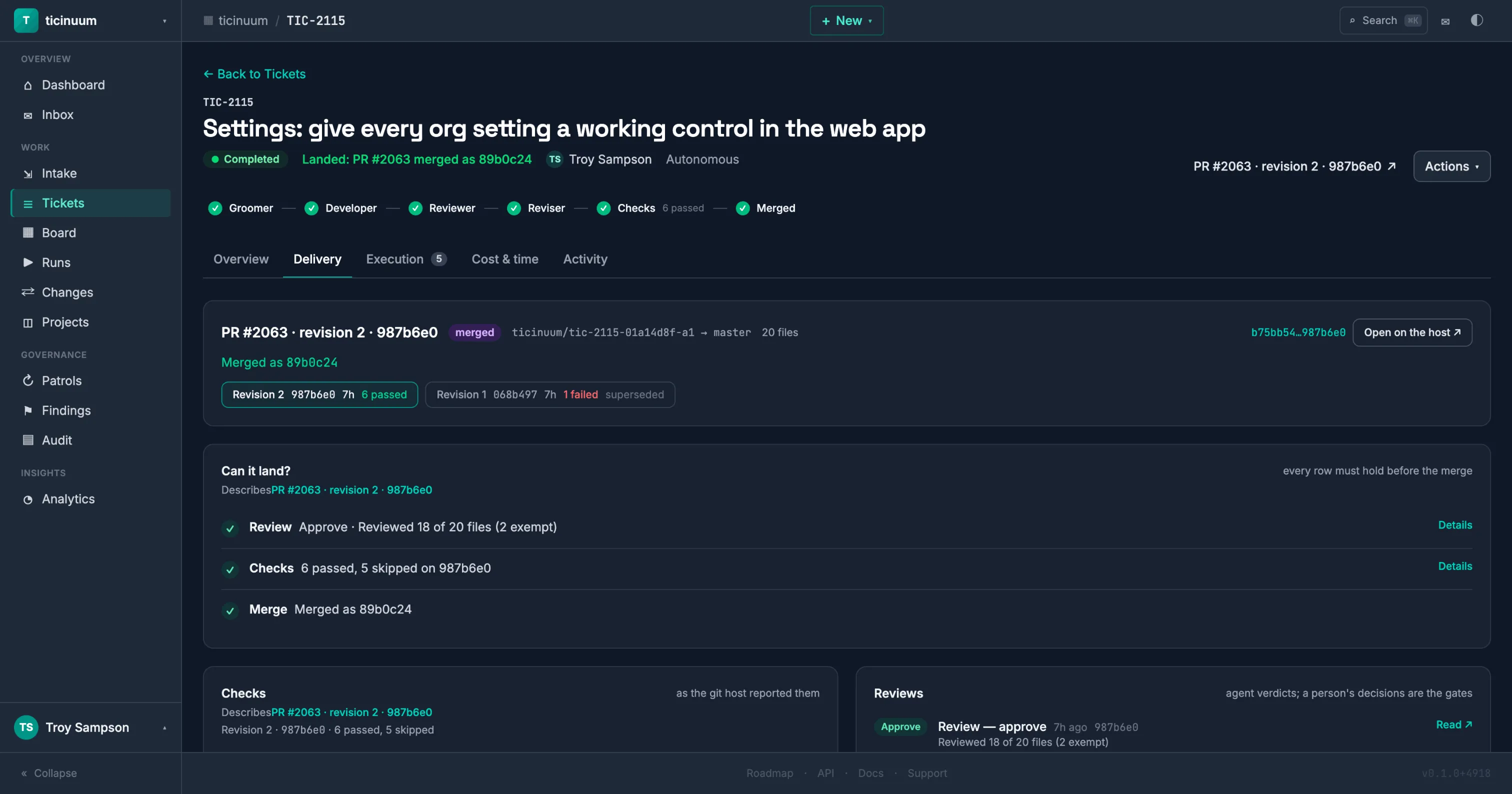
Captured from the product.
Real screens from Ticinuum’s own organization, taken in October 2026 — not mockups.
Roadmap fence
Approvals and merging: what's opt‑in, and what isn't built.
What's built but off until you turn it on, and what isn't built yet. Open any row for the whole sentence, or read the whole fence.
On the roadmap Not built yet, or built but not yet validated in use. Don't rely on these. 4 items
GovernanceOrg-level approval policy — named approvers, cost thresholds, gate expiry (today a gate comes from a ticket's mode, a change surface, a finding, or an outside review)
Qualitybuilt · not yet validatedRuntime verification — an opt-in QA stage that tests a change against a registered environment and attaches the evidence; its checks have not yet been validated in use
Qualitybuilt · not yet validatedPatrols — recurring read-only investigations on a schedule, behind the initiatives switch
QualityClosing the full circular loop — deploy → observe → feedback
Built · opt-in · off by default Shipped, but off until someone turns it on, usually your org admin, on the record. 5 items
GovernanceThe agent merging on its own — an approved autonomous PR with green checks merges with no person's click only once your OrgAdmin elects it against a recorded disclosure; the election lapses after 90 days unless re-confirmed, and isn't yet available to orgs on GitLab. Without it a person merges with one click
GovernanceThe pull loop — work that starts with no person's click — with it, tickets agents file and tickets a finished one unblocks can start on their own, and a bounded schedule pulls your backlog's top-ranked work first, under your org's work-in-progress limit, and grooms & reconciles existing tickets, capped per cycle. Two keys turn it: a SystemAdmin exposes it, then your OrgAdmin elects it against a recorded disclosure — and a material change to that disclosure lapses the consent
QualityDistinct reviewer identity — a separate reviewer App (GitHub), or an application authorized by a different account (GitLab), reviews under its own identity; without one the verdict posts as a comment under the developer
QualityCI triage & the trunk watch — Ticinuum re-runs a red check once (where your git host allows it), tells a flaky check from a broken environment from a real regression, and for a regression files a supervised fix ticket and proposes a revert a person approves and merges; a failure several changes share is reported once and fixed by one blocking ticket ranked first
QualityRe-verify before landing — a PR that has fallen behind its base branch is brought up to date and its checks re-run before it merges, one per branch in approval order (a SystemAdmin exposes it, then your OrgAdmin elects it)
FAQ
Questions, answered plainly.
Will it auto-merge my PRs?
Only once a person says yes — or once your org has chosen, on the record, to let the agent merge. Autonomous (the default): once a person presses Run, Ticinuum runs review and revise unattended, and once the review approves and CI is green a "Merge needed" item asks the ticket's owner to merge it with one click. Letting the agent make that merge on its own is a separate setting your org admin elects against a recorded disclosure — it lapses after 90 days unless re-confirmed, and isn't yet available to orgs on GitLab. Either way nothing merges without an affirmative review and green checks; a review loop that stops making progress, red checks, or a conflict it cannot resolve go to a human instead, and merges wait while someone has frozen the base branch or its checks are red. Supervised (a per-ticket choice, or your org default via one Safety and guardrails setting): the ticket waits at a gate for a person to approve it, then Ticinuum merges the approved PR for you and the ticket settles to done. If the loop escalates instead, a person can take the merge decision themselves — and that person can't be the ticket's author or owner. Your git host still owns branch protection either way.
Does it run my backlog unattended?
Not unless you choose it. By default a person starts each piece of work: filing a ticket grooms it if it needs it, then it waits until someone presses Run. From that one click an autonomous ticket goes through review to an approved, green PR with no further click — gated by the kill switch, the budget breaker and injection quarantine, held to your org's executor capacity, and never touching a quarantined or on-hold ticket — and then a person merges it. Supervised tickets also wait for a person to promote them. Work no person started — a ticket an agent files, a ticket a finished one unblocks, and a pull loop that starts your backlog's top-ranked work under a work-in-progress limit — all wait until a platform admin exposes it and your org admin opts in against a recorded disclosure of what it does and spends. (Patrols your admin schedules, and the next steps of a plan a person started, run on their own.) Issues from your tracker or git host land in Intake as requests, and nothing happens until a person admits them.
Is the review actually independent?
The reviewer is always a fresh agent in a fresh context — never the coder. Before its model weighs in, the build and test commands your repository declares run on a real checkout, and a red result blocks the change automatically; Ticinuum doesn't guess your toolchain, so with nothing declared it leaves that to your pull request's own CI, which the merge waits on anyway. It can post under a distinct identity; if you don't connect a separate reviewer identity, it falls back to the coder's identity and labels the verdict as a comment — we're upfront about that.
The rest of the deep dive
Every other guardrail, on its own page.
- AI cost controls Autonomy you can afford.
- Audit trail Every diff, decision, token, and dollar — on the record.
- Security Your key, your quota, your data.
- Data residency Choose what lands where.
- Claude Code & MCP Your engineers' sessions join the record.
- The deep dive All six on one page, with the roadmap and the comparison.
Put your backlog on the continuum.
From intent to PR to review — one durable, auditable continuum of work. Early access opens soon.
coming soon
Early access opens once the waitlist terms and privacy notice are final. Nothing to sign up for yet — this page collects no email.